
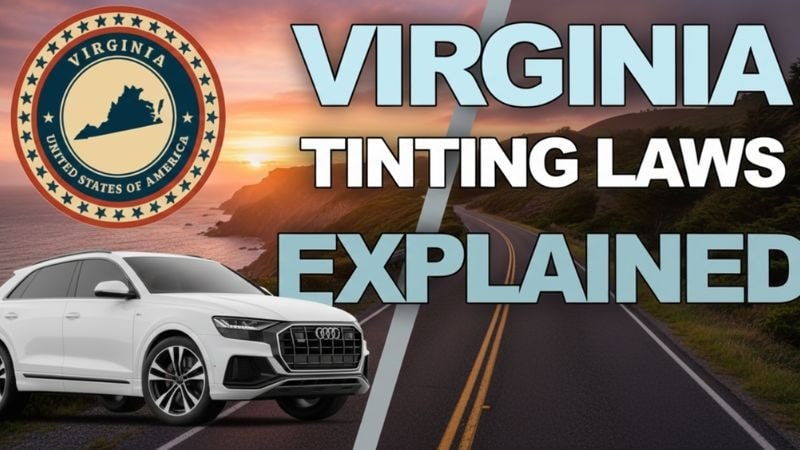
Legal tint in VA may feel like a design limit when you realize you can’t go as dark as you want. However, these laws exist for your safety. In this article, we break down Virginia’s tint regulations, highlighting key rules, do’s and don’ts, so you can stay compliant, avoid fines, and drive with confidence.
Virginia’s Window Tint Laws
Choosing the tint percentage for your vehicle’s window cannot be a matter of your personal choice just for entertainment or aesthetic. Going too dark can put your safety at risk, while staying too light will not get you the benefits of privacy, blockage of harmful UV rays, and driving comfort.
To strike the right balance, the state of Virginia introduced Virginia Tint Laws in 1999 and established clear limits on how dark your window tint can legally be, based on Visible Light Transmission (VLT).
In this section, we will discuss the permissible tint darkness limits for different vehicle types to help you choose the right tint and stay on the right side of the law.
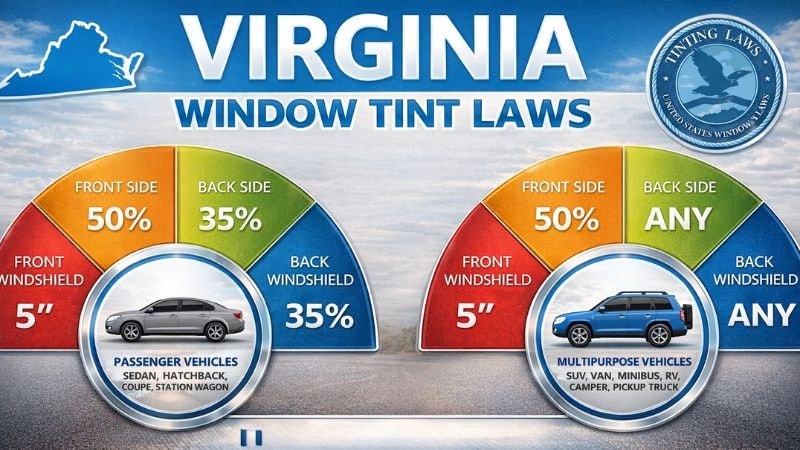
Tint Darkness for Passenger Cars:
First come the most common used passenger vehicles, such as Sedans, Coupes, and Hatchbacks, for which the tint darkness limit varies by each window. The windshield tint, for these vehicles, is limited to within the first five inches from the top, above the manufacturer’s AS 1 line.
The rear window and rear windshield’s darkest tint is 35% tint; however, the front side windows must allow at least 50% visible light transmission.
| Window | Minimum VLT Allowed | Notes |
|---|---|---|
| Windshield | Any VLT% with the AS-1 line | No tint below the AS-1 line |
| Front Side Windows | VLT cannot be less than 50% | Must allow half of the light transmission |
| Rear Side Windows | Must have at least 35% VLT | Darker tints are not allowed |
| Rear Windshield | Must have at least 35% VLT | The film can be 75% tinted |
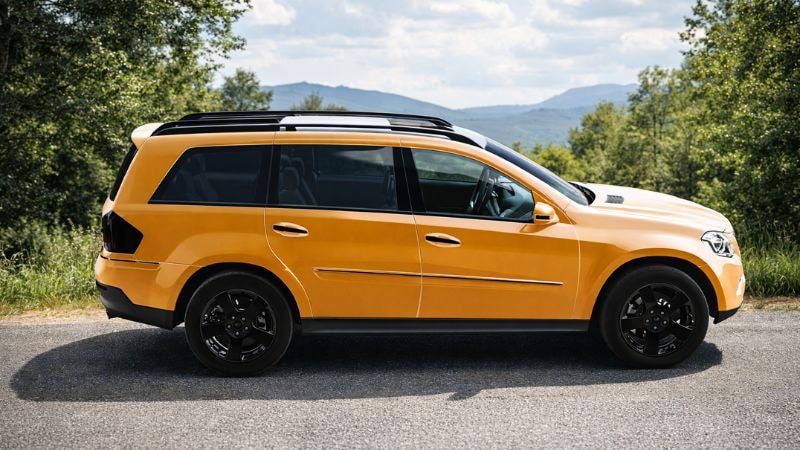
Tint Darkness for SUVs and Vans:
In Virginia, if you are behind the wheel of an SUV or van, the windshield can only be tinted above the manufacturer’s AS 1 line, the same as the Sedans. The front side windows can be lined with window films having 50% tint, which blocks half the incoming light.
Meanwhile, rear side windows and the rear windshield may use any tint percentage since no legal tint limit applies to them.
| Window | Minimum VLT Allowed | Notes |
|---|---|---|
| Windshield | Any VLT% with the AS-1 line | No tint below the AS-1 line |
| Front Side Windows | VLT cannot be less than 50% | Must allow half of the light transmission |
| Rear Side Windows | Any percentage of VLT | Can go as dark as 5% |
| Rear Windshield | Any Percentage of VLT | Can go as dark as 5% |
Window Tint Reflection in Virginia
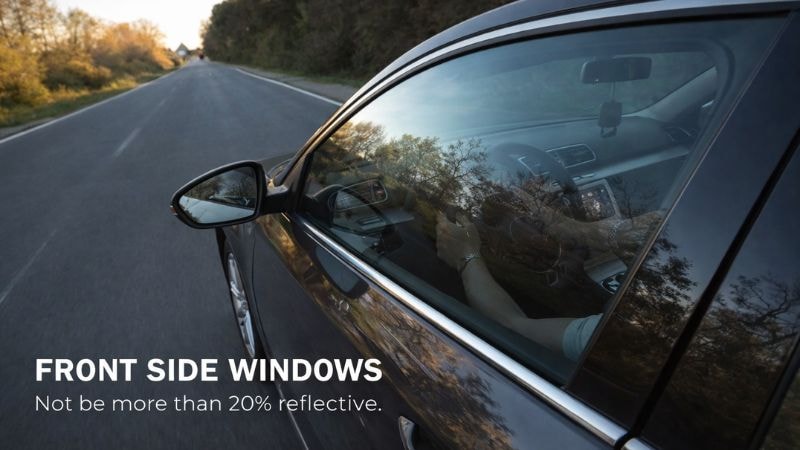
Virginia’s window tint laws also authorize the extent of reflection that can be permitted for tint films. The limit of tint reflection for the windshields of Sedans and Multi-Purpose Vehicles (MPVs) follows the same law in Virginia.
The first 5 inches of the windshield should only be covered with a non-reflective tint. However, the rule slightly varies for the other windows of these vehicles.
Tint Reflection for Sedans
For smaller cars like Sedans and Coupes, the reflectivity of the tint films for front and back side windows, as well as the rear windshield, must be less than 20%.
Tint Reflection for MPVs
The limit of reflectivity of tint films applied on the front and back side windows is up to 20% and the same goes for the backside windshield.
What Does 20% Window Tint Actually Mean?
In the language of tint films, tint percentage refers to the level of transmission of light, which establishes how much darker or lighter the film will be. This means that the film tint percentage and VLT have a direct relation.
So, a higher tint percentage indicates a higher VLT, meaning more light passes through the film, and the tint appears lighter.
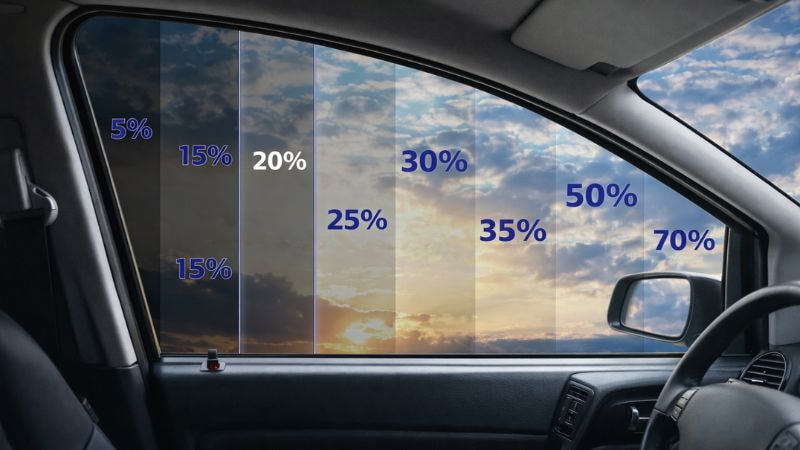
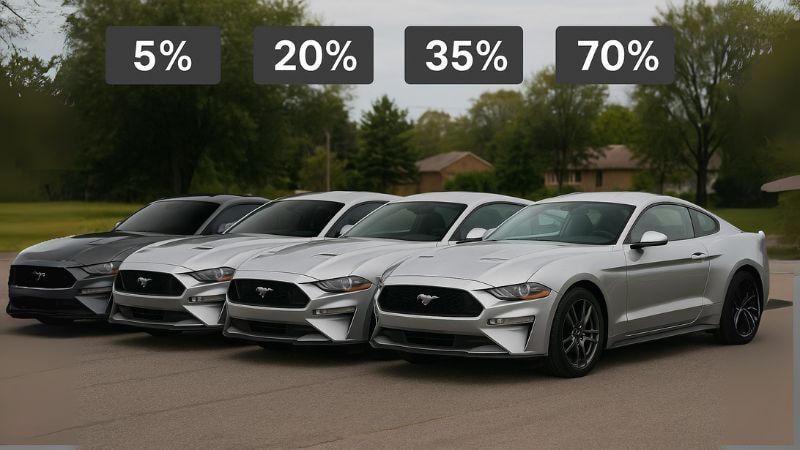
In this context, a 20% tint film is the film that only allows 20% visible light transmission and is darker than the 35%, 50%, and 70% window tint films. A 20% VLT tint blocks about 80% of the outside light from passing through.
It is the second darkest tint film, and the darkest one is the limo tint, which only has a VLT level of 5%.
Here’s a bird’s-eye comparison of different tint percentages with 20% window tint film.
| Tint Type | VLT | Visibility at Night | Tint Amount | Privacy |
|---|---|---|---|---|
| 5% | Only 5% transmission | No visibility | 95% tint pigment | Maximum |
| 20% | 20% transmission | Minimum visibility | 80% tint pigment | Strong |
| 35% | 35% transmission | Average visibility | 65% tint pigment | Good |
| 50% | 50% transmission | Good Visibility | 50% tint pigment | Minimal |
Is 20% Tint Legal in Virginia?
In general, yes, a 20% tint is legal in Virginia; however, it doesn’t mean you get a free pass to go overboard and install it on all the windows. 20% is the darkest legal tint, but only for specific vehicles and that too with specifications.
So, the following is the criterion of the Virginia window tinting law for a 20% VLT tint.
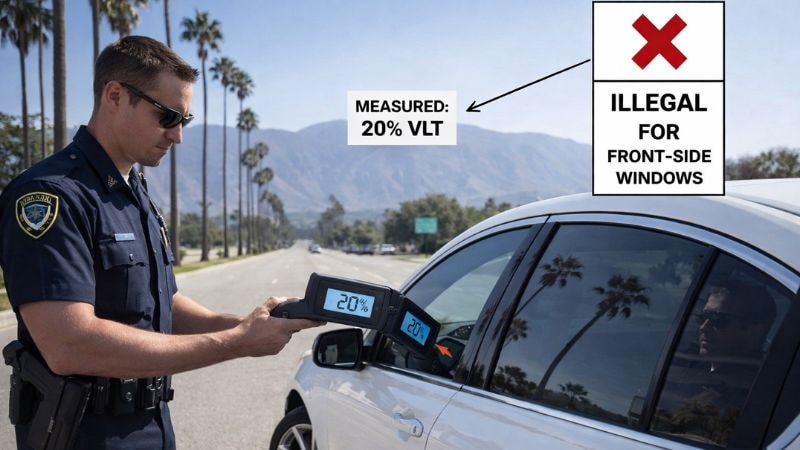
- Front Side Windows on Any Vehicle: The 20% is considered an illegal tint for the front side windows of any vehicle, whether Sedans or SUVs.
- Rear Windows on Sedans: For passenger vehicles, including Sedans, Coupes, and Hatchbacks, Virginia’s car window tint laws don’t allow 20% tint even for the rear window. However, under medical conditions, there are exemptions.
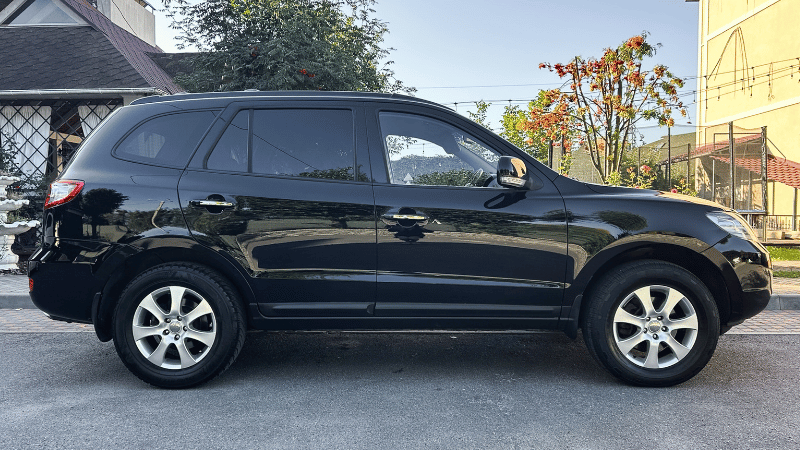
- Rear Side and Rear Windows on SUVs/Trucks/Vans: In Virginia, the 20% tint application is allowed for the rear side and rear windows of all multipurpose vehicles like vans, trucks, and other SUVs.
Other Window Tint Rules in Virginia
Apart from the percentages of the tint, window tinting laws in Virginia also have other regulations and guidelines that you must abide by. The following are the tint rules apart from the VLT and the tint levels.
- Tint Variance: Virginia’s tinting laws allow up to 7% of tint percentage relaxation to account for measurement tolerances and to prevent wrongful tint citations.
- Tint Colors: The window films with red, amber, and yellow tints are not permissible for the application.
- Dual-Side Mirrors: You are required to have dual-side mirrors if the rear windows of your vehicle are lined with window tint films.
Medical Tint Exemption in Virginia
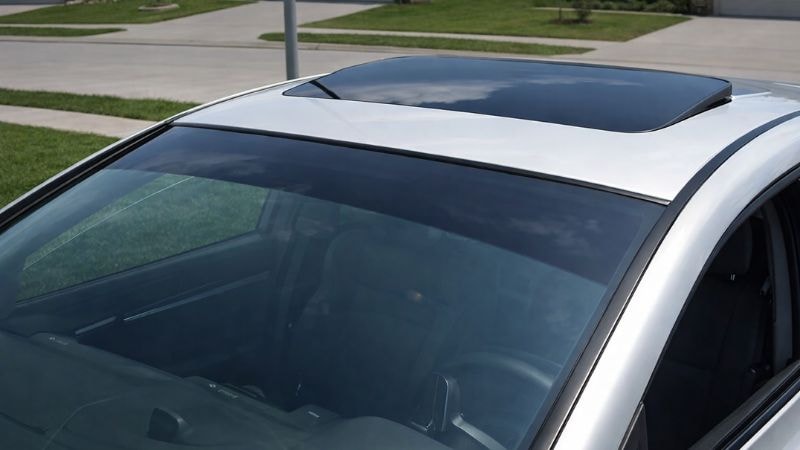
These window tinting laws are not set in stone for people with serious medical ailments with light sensitivity. Such people are exempted from the laws and are permitted to use window tint with a lower VLT than what is generally mandated for normal individuals.
However, it’s important to note that this exemption applies only to the front side windows and does not extend to other windows of the vehicle.
Individuals with the following medical conditions qualify for the exemption from the legal tint percentages:
- Lupus
- Albinism
- Porphyria
- Cockayne syndrome
- Xeroderma pigmentosum
- Migraines
Legal Tint in VA with Approved Exemption
In Virginia, once you receive approval for an exemption from standard tint laws, the following tint limits and tinting criteria apply.
- Front Side: With a medical exemption, the front side windows can be covered with 30% tint film.
- Rear Windows & Windshield: The rear side windows and windshield don’t fall under the exemption, and must be tinted in compliance with the standard window tinting laws of Virginia.
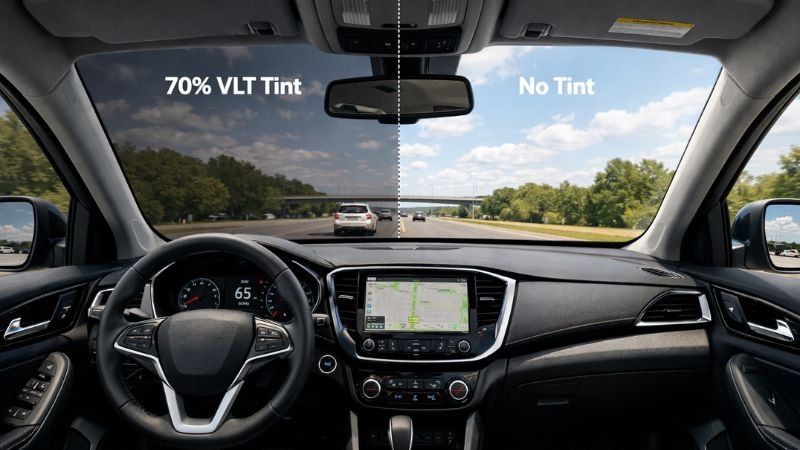
- Front Windshield: For the front windshield film, you can either have up to 35% tint on the top 5 inches or 70% tint over the wholewindshield.
Penalties for Illegal Tint in Virginia
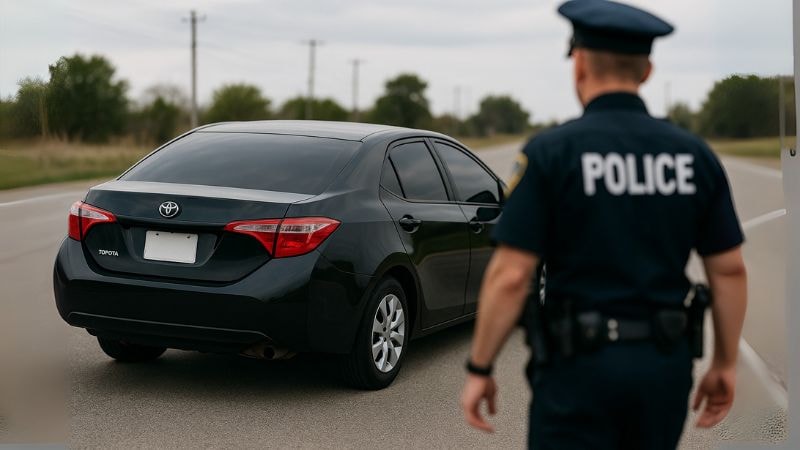
In the scenario of window tint violation in Virginia, you will face severe penalties depending on the extent and frequency of the violation. A law enforcement officer is not allowed to pull you over solely for a darker tint.
However, once they stop you for other traffic infractions, you can also be charged for an illegal tint.
First Offence
In Virginia, a first-time window tint violation is treated as a class 3 misdemeanour and is subjected to a fine of under $500.
Repeat Offences
Upon repeated offence of having a darker window tint than what is mandated, you will fall under class 2 misdemeanour. In this, you can face imprisonment for a period not exceeding six months, a monetary penalty of up to $1,000, or both.
Conclusion
For many drivers, window tint laws in Virginia feel like an unnecessary hassle. However, it must be understood that only law can draw a line between what’s too dark and what’s permitted for your own safety and that of others on the road. Ultimately, when you follow the legal tint limits, you avoid penalties.
Grow Your Window Tint Business with CarLike®
CarLike®‘s window tint films are built for B2B success. Start with low MOQs, rely on strict quality control, and customize with flexible OEM & ODM options. With lightning-fast production, global shipping, and 24/7 professional support, we help you deliver projects faster and scale with confidence.
Contact us today to request a quote and secure a dependable supply.
FAQs
Q1: Can I tint the entire windshield of my vehicle?
In Virginia, the windshield is only allowed to be tinted upto the manufacturer’s AS 1 line under normal conditions. However, in medical exemption, the windshield can be tinted with a film of 70% VLT.
Q2: What happens if my tint is slightly darker than the limit defined by law?
Virginia law allows a 7% VLT variance, so a minor deviation does not count as an offence. That being said, anything beyond this tolerance can still result in penalties.
Q3: What makes your window tint films stand out?
Our window tint films are made from high-quality materials, providing superior UV protection, heat rejection, and enhanced privacy. They are durable, easy to install, and available in various tint levels to meet diverse needs.
Q4: What is the minimum order quantity (MOQ) for window tint films?
Our standard MOQ is 10 rolls, but we are flexible and can accommodate smaller orders to help new customers evaluate our products.